
New lower price
0 added
0 Duchy Organic Strong White Bread Flour in trolley.
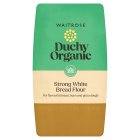
Item price
£2.00Price per unit
£1.34/kg
Please note, we take every care to ensure the product, allergen and recipe information displayed is correct. However, should a product be unavailable, alternatives may be displayed and/or a substitution provided. If you have an allergy or intolerance, please always check the product label before use.
Mix the flour, yeast, salt and sugar in a large bowl. Make a well in the middle and pour in the oil and 130ml hot water. Mix together with a wooden spoon until combined, then bring together with your hands. Knead by hand on the work surface for 8-10 minutes, only dusting with a little flour if it's sticky.
Once the dough is smooth and shiny, turn it in your hands, tucking under to make a smooth dome on top. Place seam-side down on a floured baking tray; gently pat down the top to flatten slightly. Cover with a sheet of lightly oiled cling film and leave to rise for 1 hour 15 minutes.
Preheat the oven to 200˚C, gas mark 6. Uncover the dough and, using a sharp serrated knife, make three 0.5cm-deep slits across the top. Cover again and leave for 15 minutes.
Uncover, dust the top with a little more flour and bake for 25-30 minutes, until golden. Transfer to a wire rack and leave to cool completely before slicing and serving with butter.
Typical values per serving when made using specific products in recipe
Energy | 639kJ/ 152kcals |
|---|---|
Fat | 4.4g |
Saturated Fat | 0.7g |
Carbohydrates | 24.2g |
Sugars | 1.1g |
Fibre | 1g |
Protein | 3.8g |
Salt | 0.6g |
Book a slot to see product availability at your nearest Waitrose & Partners store
0 added
Item price
£2.00Price per unit
£1.34/kg0 added
Item price
£1.90Price per unit
£19/kg0 added
Item price
£1.75Price per unit
£5/kg0 added
Item price
£2.65Price per unit
£2.65/kg0 added
Item price
£5.95Price per unit
£1.19/100ml